




BC Poker India: Find Your Rhythm Across Real-Money Poker Tables
For players in India, BC Poker combines cash tables, tournaments and freerolls. Texas Hold’em, Pot Limit Omaha and 6+ Short Deck cover distinct styles, while fast formats suit shorter sessions. Browser access, the BCPoker app and desktop play share one profile. Open the lobby to compare three core disciplines before choosing a table.
Key Takeaways
- Which cash games, tournaments and fast poker formats are available;
- How freerolls and satellites provide alternative tournament entry routes;
- What current rewards are linked to deposits, newcomer missions and regular play;
- How one account works across supported browser, mobile and desktop access.
Open the lobby to compare three core disciplines before choosing a table.
BCPoker Cash-Table Hub for Real-Money Sessions and Freeroll Entry
For Indian users, BC Poker online mixes paid tables and free-entry tournaments. Cash games run as open ring sessions. Freerolls follow scheduled structures.
You can choose flexible or fixed-start play. Each route makes different bankroll demands. Both remain in one lobby.
Freerolls as a No-Buy-In Route into Poker
Freerolls remove the entry fee while retaining real prizes. They can introduce tournament flow before you commit funds. Registration appears with other events.
Standard rules apply once play begins. Your stack still determines survival. Freerolls are excluded from the usual re-entry option.
Cash Games for Regular Real-Money Table Sessions
Cash-table chips represent money committed for that session. You can choose a discipline without awaiting a start. Stakes and seats vary by table.
This format gives direct control over session length. You may leave without surviving a field. Results settle through the table balance.
Three Poker Disciplines with Different Cards, Limits and Hand Rankings
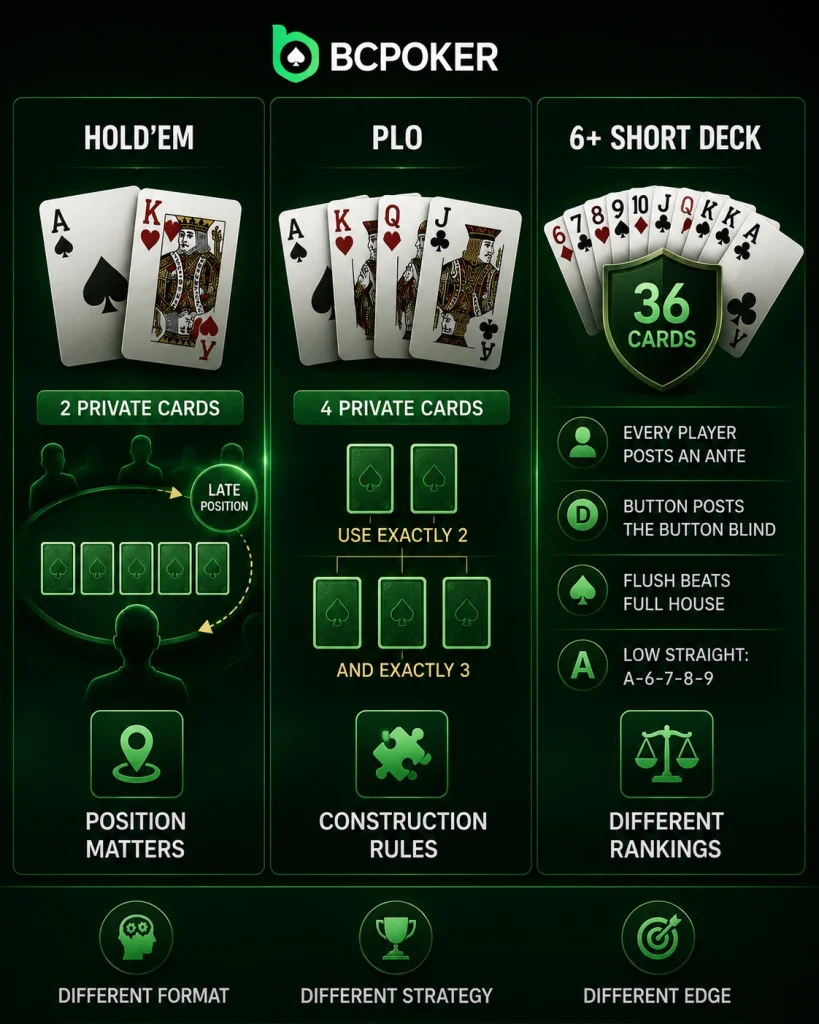
Across BC Poker, Hold’em, PLO and 6+ Short Deck use different card structures. Hold’em starts with two private cards. PLO starts with four.
Short Deck changes the pack. Its hand hierarchy also differs. Moving formats requires different starting-hand decisions.
Hold’em Position and PLO’s Four-Card Construction
In Hold’em, position changes available information before you act. Later seats see more opponent decisions first. Starting-hand value should reflect position.
PLO gives each player four private cards. The final hand uses exactly two. Exactly three community cards complete it.
Short Deck’s 36 Cards, Button Blind and Altered Rankings
Short Deck uses 36 cards after removing ranks 2 through 5. Every player posts an ante. The button posts the button blind.
A flush ranks above a full house. Its low straight is A-6-7-8-9. These rules change familiar Hold’em assumptions.
BCPoker Tournament Journey from Open Registration to Target-Stack Qualification
Tournament options include MTTs, free-entry events, Re-Entry structures and satellites. Registration takes place through the poker lobby, while supported Re-Entry events allow another registration after elimination. MTTs begin across multiple tables, and satellites provide qualification routes into larger tournaments. bles. Satellites can award entry to larger events. Each structure creates a different route.
MTT Tables That Merge as the Field Gets Smaller
MTT tables merge as players leave. Remaining players eventually reach one final table. The field therefore contracts by table.
Three lobby details matter:
- cancel registration up to 3 minutes before the start;
- re-enter from the lobby after the prompt closes;
- staking applies only to the first entry.
Re-entry counts as new registration. A new fee applies each time. Entry caps appear in the lobby.
Target Stack Seats Awarded at a Defined Chip Goal
A Target Stack satellite awards a seat at the required chip amount. Qualification happens immediately, not at a survivor count. The qualifier and target stack leave.
Excess chips follow satellite distribution rules. One participant cannot win multiple seats. Won tickets remain in the account ticket area.
Short-Session Poker Through Spin Multipliers and All-in-or-Fold Shootouts
Spin & Go and All-in or Fold Sit & Go provide two different fast-format structures. Spin & Go uses a three-player setup with a random prize-pool multiplier, while All-in or Fold begins with 16 players across four tables, with each opening-table winner advancing to the final.
Three-Player Spins and a 16-Player Shootout Structure
All-in or Fold gives every participant three starting stacks. Players may commit one or more stacks. Finalists receive a fresh set.
Every finalist is already in the money. Spin & Go keeps its three-player structure. Its defining variable is the pre-game multiplier.
BCPoker Player Rewards in India Across Deposits, Cash Tables and Leaderboards
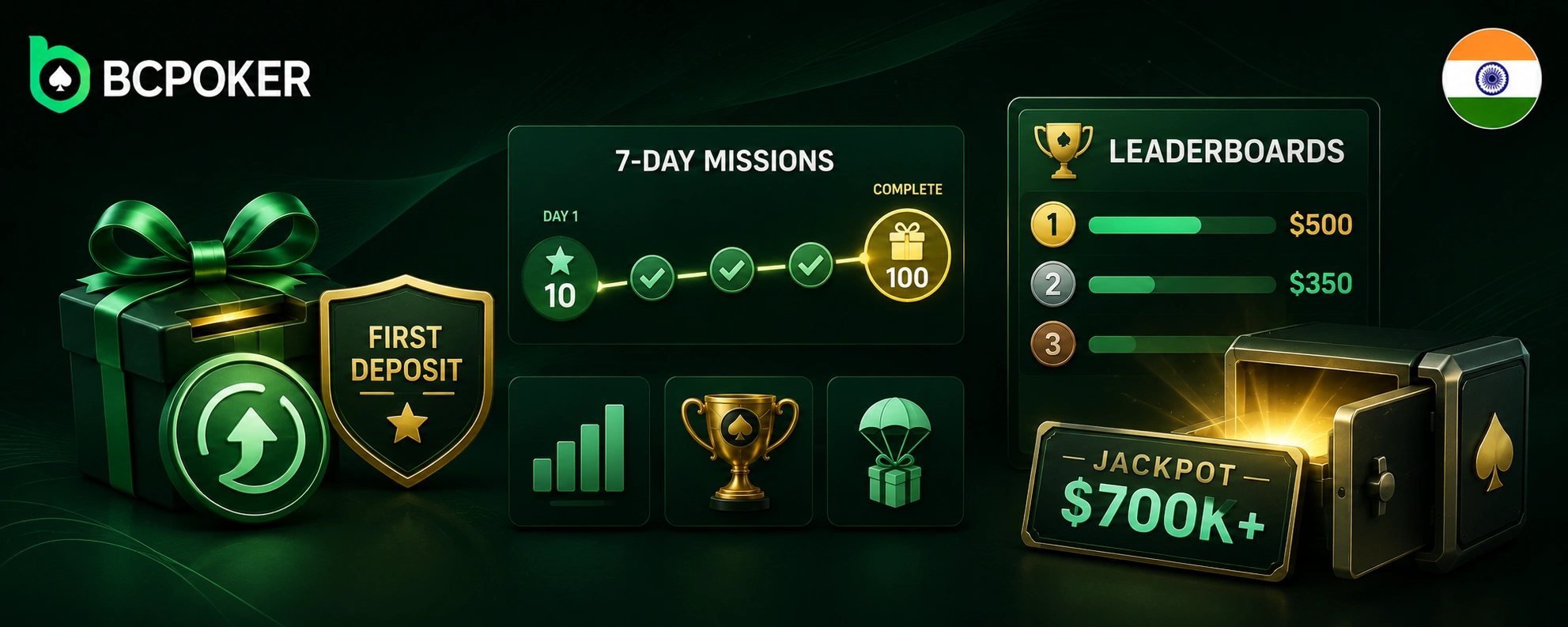
For India-facing users, BC Poker lists up to $200 on a first deposit, a $130 7-Day Newcomer Gift and a $5 app-registration reward. The deposit reward arrives immediately. Newcomer missions refresh three tasks daily.
The programme lasts seven days. App registration activates those missions. Each offer covers a different account stage.
First Deposit Offer and Seven-Day Newcomer Missions
The first-deposit reward applies across eligible cash games and tournaments. It unlocks in $0.0001 increments through valid play. No time limit applies.
Newcomer missions use cumulative points. Day 1 starts at a 10-point threshold. The full reward unlocks at 100 points.
Leaderboards, Jackpot and Automatic Prize Drops
Current BC Poker promotions list an NLHE daily leaderboard up to $500 and Spin & Go up to $350. The Spin ranking pays 20 places. First receives $100.
| Promotion detail | Current rule |
| NLHE $1-200 BB | Top 20 share $350 |
| NLHE $0.05-0.5 BB | Top 30 share $150 |
| Spin & Go scoring | Buy-in × 4 |
| Jackpot payouts | Royal Flush 20%, Straight Flush 10%, Four of a Kind 2% |
A separate jackpot exceeds $700,000 for qualifying hands. Lucky Drop can trigger on eligible NLHE cash tables. Rewards credit automatically.
Moving Money Between INR, Crypto Wallets and the Poker Balance
For Indian players, BCPoker supports INR-facing UPI and UPI App routes alongside crypto. The general minimum deposit is $5. Selected promotions can require at least $10.
Crypto funding requires a matching network. The asset symbol alone is insufficient. Check both asset and chain before confirming.
UPI Access, Digital Coins and Network Selection
Supported crypto examples include USDT, USDC, BTC, ETH, BNB and SOL. Stablecoins reduce some coin-price exposure. Copy the deposit address from the cashier.
Choose the same network in the sending wallet. Some assets support several chains. Incorrect routing can make recovery difficult or impossible.
Playing the Same Poker Account Across Browser, Phone and Desktop
With BC Poker, one profile works across supported browser, mobile and desktop access. Separate identities are unnecessary per device. The web version needs no installed client.
Mobile access keeps the same profile. A Download section provides installable software. Supported systems can use the route that fits.
Shared Access to Games, Profile Functions and Player Balance
Through BC Poker, one sign-in connects game sections, profile tools and balance. Registration can start by email or phone. Browser and app routes use the same profile.
Device changes need no new registration. Account recovery is preferable when details are lost. One verified profile avoids duplicate-account conflicts.
BCPoker Transparency Through Verifiable Shuffles, Reserves and Licensing
At BC Poker, trust controls cover reserves, shuffle verification and licensing. Proof of Reserves covers user balances 1:1. Additional reserves are held.
Corporate holdings stay outside that calculation. A decentralized RNG handles shuffling. The platform operates under an Anjouan Gaming License, not an Indian licence.
1:1 Asset Coverage, KECCAK-256 and the Anjouan License
BC Poker uses KECCAK-256 in its decentralized random process. Table participants contribute shuffle input. Completed hands can be checked for randomness.
The verifier also shows undealt cards. Review happens after each hand. Players can therefore inspect a completed shuffle directly.
Account Safeguards and Responsible Play Assistance for Users in India
For users in India, BC Poker combines account security with responsible-play controls. Two-factor authentication adds a sign-in layer. Monitoring flags suspicious activity and unfair behaviour.
Cooling off can pause play for seven days. Self-exclusion can last at least six months. Both provide defined breaks from real-money play.
Two-Factor Protection, Support and Self-Exclusion Options
With BC Poker, 24/7 Live Chat and official channels help with account issues. Security prompts can appear around sensitive actions. Support assists when login details are lost.
Three recovery details help:
- verify the registered email before a reset;
- check inbox and spam for verification mail;
- contact support if email or username is forgotten.
Users must meet their jurisdiction’s lawful age requirement. Responsible-play tools can restrict participation. Support remains available for unresolved access issues.